


A CleanCut bathtub conversion removes and finishes a measured section of an existing tub wall to create a lower step-through opening. The tub stays in place. The change is focused on the side wall that a person crosses, rather than replacing the entire bathing fixture or rebuilding the whole bathroom.
Page updated .
EazyStep Bath evaluates existing tubs for CleanCut Step conversions across its Lexington, Jackson, and West Tennessee service area when the tub wall is the main obstacle and the household wants to keep a compatible fixture.
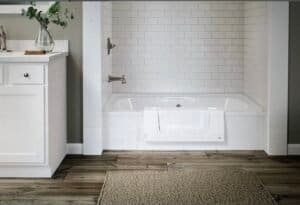
What physically changes in a CleanCut conversion?
The change happens at one section of the bathtub side wall. The opening is planned for a compatible location, a section of the wall is removed, and the selected insert is fitted with its support components. The finished opening leaves a lower threshold to cross than the original full-height tub wall.
This is why the terms tub cutout, bathtub conversion, and step-through tub conversion often appear in the same search. They describe a focused modification to an existing bathtub. They do not describe removing the tub and installing a different fixture.
The manufacturer describes the CleanCut Step as a product that converts an existing tub into a step-in shower. Its product page also makes clear that sizing varies with the thickness of the tub rail. The useful point is not that every tub has a matching insert. It is that the opening and product must be selected from actual tub measurements.[10]
How does a bathtub cutout installation work?
For a CleanCut Step, the work moves from inspection and protection to cutting, fitting, support, sealing, and a wait before use. The manufacturer supplies a cutting template, support components, and adhesive as part of the kit. This is a homeowner overview, not cutting instructions.[13][10]
Before the tub is cut
The installation guide calls for checking existing damage, confirming fit, and choosing the opening location before cutting. Nearby fixtures and a shower seat can affect where the opening belongs. Ask the installer to explain the proposed location and the remaining step before approving the work.[13]
Protection is part of the job. The guide calls for clearing personal items, covering the tub bottom and drain, and protecting surrounding surfaces from debris. It specifically warns that cutting cast iron creates significant dust. Discuss access and protection for your bathroom rather than assuming every tub creates the same working conditions.[13]
Fitting the opening and supporting the Step
After the section of tub wall is removed, the Step is fitted to that particular opening. The guide describes repeated fit checks and a support structure beneath the insert, adjusted for the conditions inside the tub wall. Cutting the opening is only part of the installation; the fitted insert also needs support.[13]
The installer then secures the components and seals the perimeter with the specified adhesive. The guide calls for checking the less-visible underside of the seal with a mirror. At handover, ask what has been checked and which care instructions apply to the installed product.[13]
Installation time is not the same as time until use
The current CleanCut Step product page lists installation in 2 to 4 hours. The Step installation guide currently linked from the manufacturer sizing page separately says not to use the tub for 2 days while the adhesive cures. Those statements refer to different parts of the schedule. Neither is an EazyStep Bath appointment guarantee.[10][13]
Before work starts, ask for the expected work period and the earliest permitted return to use in writing. Follow the instructions supplied for the actual product and adhesive; if they differ from the online guide, have the installer resolve that difference before you use the tub. Plan another bathing arrangement for the required waiting period.
The guide also calls for leaving care and use information with the homeowner. Keep that information rather than relying on a general online description after installation.[13] If fit is still undecided, use the existing-tub candidate checklist before arranging the work.
How to prepare for a CleanCut installation visit
For a confirmed installation, clear personal belongings from the bathroom, confirm the product and opening location with the installer, and arrange another way to bathe during the required wait before use. If the appointment is only an assessment, do not prepare the room as though cutting has been approved.
- Confirm what the visit covers. Ask whether it is a tub evaluation, final measurement, or installation. Keep the agreed model, intended bathing use, and any enclosure changes together with the appointment details.
- Clear what you can move safely. Put toiletries, towels, loose rugs, and fragile belongings outside the work area. The manufacturer calls for removing personal items to protect them from dust and debris. Leave tub and drain protection to the installer rather than taping over damage that needs inspection.[13]
- Point out changes before work begins. Report a new crack, leak, movement, or earlier repair. The Step guide calls for an existing-damage check and a dry tub area. Ask when to stop using the tub so the installer can assess the actual conditions.[13]
- Agree on access and household arrangements. Explain entry or parking restrictions and keep children and pets out of the work area. Ask before removing fixtures, disconnecting anything, or taking down an enclosure.
- Plan the handover. Ask for the earliest permitted use time and the product care instructions in writing. Make the bathing arrangement before work starts, not after the tub is unavailable.
Bring questions about the entry movement, but do not demonstrate a difficult step or transfer for a photograph. A photo can show the tub without anyone standing in it. For general property-access preparation, see the Lexington appointment guide or the Jackson appointment guide.
What stays in place?
The bathtub remains the main fixture. Its floor, drain, faucet, surrounding walls, and basic footprint are not automatically replaced by the conversion. That smaller scope can be useful when the tub and surrounding area are otherwise serviceable and the main obstacle is the height of the side wall.
Keeping the tub also means keeping many of its existing conditions. A conversion does not repair hidden water damage, change a poorly located control, create more dry-floor clearance, or correct every problem with the room. Cracks, movement, corrosion, liners, jets, wall profiles, and enclosure hardware can affect whether the focused modification is appropriate.
For a broader comparison of a cutout, transfer equipment, grab bars, and fixture replacement, read Options When a Bathtub Wall Is Difficult to Step Over. That guide starts with the difficult movement. This article stays with the narrower question of what the CleanCut product changes.
Want to know whether the existing tub is worth evaluating?
EazyStep Bath evaluates compatible tubs for CleanCut Step bathtub installation in Lexington and Henderson County, Jackson and Madison County, and nearby West Tennessee communities. Mike reviews the tub, measurements, enclosure, access, and intended use before confirming a scope.
Open and convertible configurations serve different uses
An open step-through insert leaves the converted section open. In practical terms, the bathtub is then used as a step-through shower rather than being filled to its original depth. The manufacturer presents the CleanCut Step in this category.
The CleanCut Convertible uses a removable center insert. CleanCut says that center section allows the tub to change between a step-in shower configuration and a full bath configuration. That distinction matters in a home where different people use the same tub or where full-depth bathing still needs to remain possible.[15]
There are other CleanCut configurations for different tub profiles and opening goals. Product names alone should not drive the decision. First decide whether the household needs an always-open passage or the ability to close the opening for bathing. Then compare that need with the tub dimensions, remaining threshold, and product requirements.
What does a CleanCut tub conversion not do?
- It does not create a zero-threshold shower. A lower step remains, and its height depends on the original tub and selected product.
- It does not replace the whole tub. Existing conditions elsewhere in the fixture and room remain relevant.
- It does not provide every needed handhold. If a person needs support during entry, turning, or standing, a separately selected and properly mounted grab bar may need evaluation.
- It does not make a shower door a support device. Door glass, frames, and handles are enclosure components, not grab bars.
- It does not establish that the movement is appropriate for a particular person. Pain, balance, strength, recovery restrictions, or cognitive concerns may call for evaluation by an occupational therapist or another qualified health professional.
These limits are important because a lower wall and an easier movement are not always the same thing. Use the bathroom mobility checklist to review the approach path, wet surfaces, lighting, controls, handholds, and exit route as one sequence.
What must be evaluated before selection?
Intended bathing use
Decide whether the opening can remain open for shower use or whether the household needs a removable center for full-depth bathing.
Tub measurements and profile
Measure the wall height, rail thickness, inside and outside surfaces, and available opening area. Product requirements differ.
Tub condition and construction
Identify the material if possible, then check for cracks, movement, corrosion, prior repairs, a liner, jets, or an unusual wall shape. CleanCut does not recommend installation over a tub liner. Its FAQ says a jetted tub needs professional review; if a conversion is possible, the jets must be capped and will no longer work. CleanCut excludes clawfoot tubs.[14]
Enclosure and water control
Review tracks, doors, curtains, fixtures, and the direction of spray. The manufacturer’s current FAQ says sliding tub doors must be removed and cannot be reinstalled after its conversion.[14]
Photos help, but they are not a substitute for measurements and site review. Useful images show the complete tub, the outside wall, the inside basin, both ends, the faucet and drain, the existing enclosure, and the floor area in front. Do not assume a standard size from the home’s age or the tub’s appearance.
How should a homeowner decide the next step?
Start with one sentence: “We want to keep this tub, but the full-height wall is the obstacle.” If that statement is accurate, a focused tub conversion deserves evaluation. If the real problem is standing balance, seated transfer, a damaged fixture, controls that cannot be reached, or a room with inadequate clearance, another category may fit better.
Next, choose the intended use. An always-open step-through and a closable opening solve different household needs. Finally, have the actual tub evaluated before buying a product or planning the cut. The selection should follow the tub and the user’s movement, not the other way around.
CleanCut bathtub conversion questions
Is a CleanCut conversion the same as replacing a bathtub?
No. A measured section of the existing tub wall is removed and fitted with an insert. The bathtub and its basic footprint remain in place.
Can the bathtub still hold water after a CleanCut conversion?
An open Step configuration is intended for step-through shower use. A compatible Convertible configuration uses a removable center insert so the opening can be closed for full-depth bathing.
Does a CleanCut conversion remove the whole bathtub threshold?
No. It lowers one section of the tub wall, but a threshold remains. Its approximate height depends on the original tub dimensions and selected product.
Can every existing bathtub be converted?
No. Dimensions, wall profile, material, condition, liners, jets, enclosure hardware, and surrounding access can affect compatibility and the final scope.
Evaluate the tub before selecting the insert
Ask Mike to review the existing bathtub
EazyStep Bath can evaluate a focused CleanCut Step request in Lexington and Henderson County, Jackson and Madison County, and nearby West Tennessee communities by appointment at the customer property. Final suitability depends on the tub, measurements, condition, enclosure, intended use, access, and site conditions.
Explore CleanCut Step installation Call EazyStep Bath Request a tub evaluation
Sources and scope
- [10] CleanCut Step product information
- [13] CleanCut Step installation guide linked from the current sizing page
- [14] CleanCut product and compatibility FAQ
- [15] CleanCut Convertible product information
- [16] CleanCut Ultra-Low product information
Manufacturer sources reviewed October 13, 2026. Instructions supplied for the installed product and adhesive control the work and return to use.
This article is a product explanation, not medical advice, an occupational-therapy assessment, a code-compliance determination, or a promise that a product will prevent a fall or injury. CleanCut is the product manufacturer. EazyStep Bath provides a local installation service and does not claim manufacturer endorsement, certification, dealership status, or affiliation. Product instructions, the user’s needs, and site conditions control the final choice.