


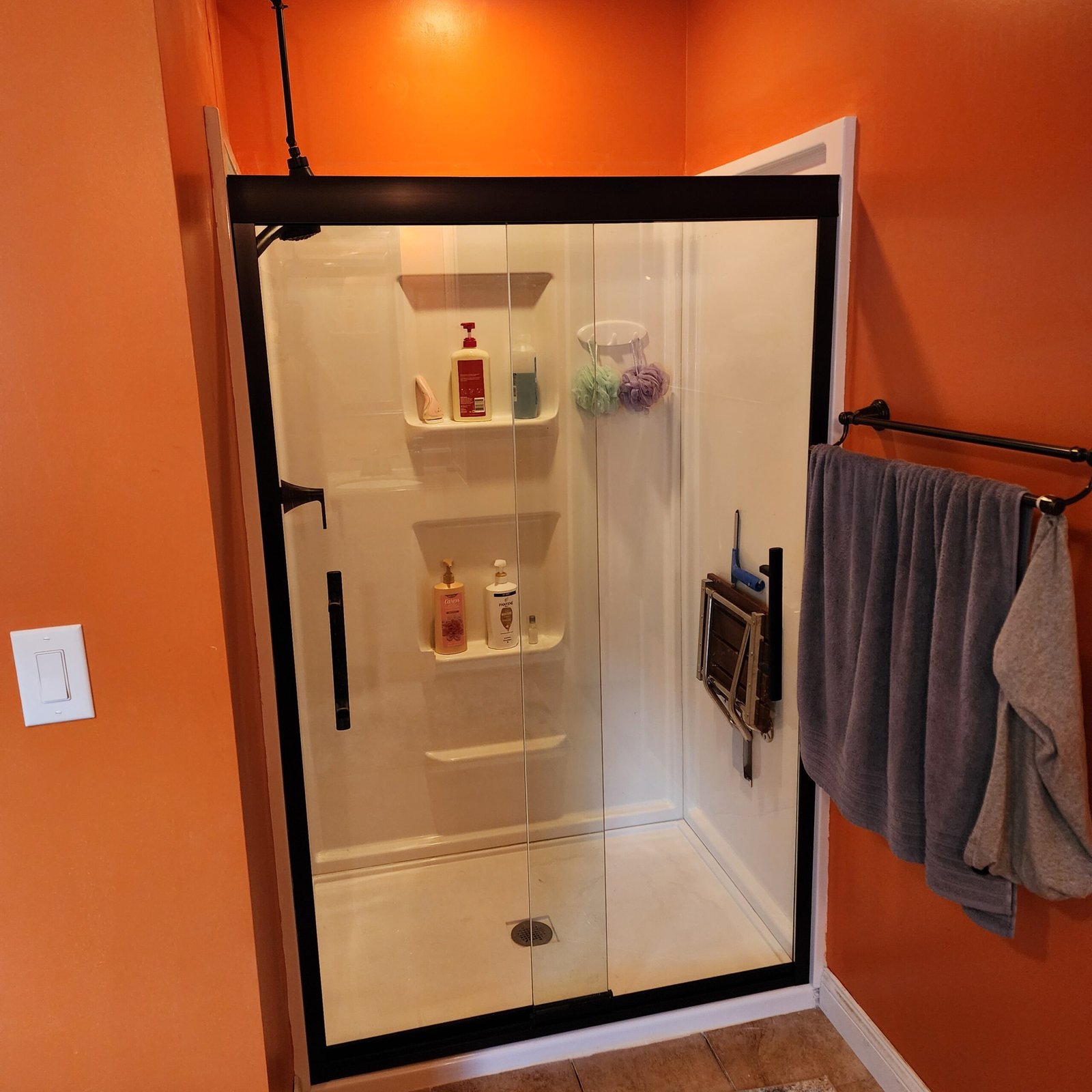
The practical difference between framed, semi-frameless, and frameless shower doors is how much metal surrounds and supports the glass. Framed systems use the most perimeter framing. Semi-frameless systems leave selected glass edges exposed. Frameless systems use minimal hardware and rely more heavily on the glass and mounting points. The label narrows the choices, but the finished opening and exact product still decide what fits.
EazyStep Bath helps homeowners compare frame style with the requirements of a compatible shower door installation across its Lexington, Jackson, and West Tennessee service area, because the amount of metal matters only after the door can fit and operate in the existing opening.
What framed, semi-frameless, and frameless mean
A framed enclosure has metal framing around the door opening and glass panels. The frame creates a visible outline and provides the structural system for thinner glass used in many framed products. Tracks, channels, uprights, headers, and seals vary by model, so “framed” does not identify one operating pattern or one installation method.
A semi-frameless enclosure removes framing from selected edges while retaining it elsewhere. This is the category most likely to cause confusion. Basco’s manufacturer comparison describes framing beside a larger panel but not around the door panel, while noting that the stationary panel may or may not have a complete frame. Delta’s comparison of its product categories shows a semi-frameless example with substantial side pieces plus top and bottom tracks. Both descriptions are valid for their products. Neither creates a universal definition for every model on the market.
A frameless enclosure uses minimal hardware and leaves glass edges exposed rather than enclosing the panels in a perimeter frame. Hinges, clips, handles, sweeps, seals, and other hardware are still present. “Frameless” does not mean hardware-free, gap-free, or suitable for every opening.
How the styles differ in daily use
Framed
Visual effect: The frame forms a clear border around the glass.
Practical tradeoff: More channels and framed edges create more detailed cleaning points, but the product may offer a simpler installation path than a frameless system.
Semi-frameless
Visual effect: Some exposed glass edges reduce the amount of visible metal.
Practical tradeoff: It keeps parts of a framed structure, but the exact tracks, side pieces, header, and exposed edges depend on the model.
Frameless
Visual effect: Minimal hardware leaves more of the glass and shower finish visible.
Practical tradeoff: Fewer framed edges may simplify wiping, while the heavier glass, hardware placement, mounting conditions, and installation precision require closer review.
There is no responsible “best” category without an opening and a use case. A framed system may make sense when its fit range, adjustment method, and defined perimeter suit the site. Semi-frameless may preserve some of that structure while reducing visual metal. Frameless may offer the least interrupted view, but appearance does not cancel mounting, clearance, glass, or water-management requirements.
Cost also belongs to the exact proposal, not a generic internet ranking. Basco currently describes framed products as typically costing less than frameless products and frameless installation as more complicated. That is a useful direction for comparison, not a price quote. Door dimensions, operating type, glass, finish, hardware, custom work, opening corrections, and installation scope can change the actual choice.
Compare the style after the opening is checked
EazyStep Bath evaluates the finished width, wall and threshold conditions, operating path, mounting surfaces, and exact product requirements for compatible shower door installations. The current service scope includes compatible framed and semi-frameless systems.
Why the finished opening can overrule the preferred style
Frame style is only one layer of the decision. The complete shower door selection guide starts with the finished opening, multiple width readings, wall plumb, threshold level, usable mounting area, nearby fixtures, door movement, and showerhead direction. Those conditions can eliminate a product before color, glass pattern, or hardware finish matters.
Do not assume that more framing automatically fixes an irregular opening or that frameless glass automatically requires perfectly square walls. Adjustment ranges and installation methods are product specific. Check the specification sheet and installation instructions for the exact model. Compare the measured opening with the stated fit range, allowable adjustment, required flat surfaces, handing, panel orientation, fasteners, and support conditions.
Keep frame style separate from operating type. A door can be sliding, bypass, pivoting, or hinged, and those moving parts create their own space and access questions. A pivot door may conflict with a toilet or vanity regardless of how much frame surrounds the glass. A sliding system avoids a room-side swing arc but adds tracks, guides, overlap, and walk-through-width questions. The calendar’s later sliding-versus-pivot guide will address that decision in detail.
A shower door remains an enclosure component. It is not a grab bar or support device. If someone needs a purposeful handhold during entry or exit, review grab bar placement separately and coordinate it with the glass, frame, controls, and door path.
Cleaning and water management depend on details, not just the label
Framed systems have more channels, corners, and joints where water and residue may collect. Frameless systems expose more broad glass area and have fewer framed edges. Delta describes its frameless products as easier to clean because they have fewer edges and crevices. That does not mean frameless glass stays clean by itself. Glass still needs routine care, and hinges, clips, handles, sweeps, seals, and the threshold still need inspection and cleaning.
Semi-frameless cleaning depends on which edges remain framed. Look at the bottom track, header, wall channels, panel overlap, seals, and access around the hardware. A model with fewer visible frame pieces can still have a detailed lower track. Ask whether each part can be reached without special disassembly and follow the manufacturer’s cleaning instructions.
Do not equate less metal with guaranteed water containment. Water management depends on the complete enclosure: showerhead direction, curb or tub ledge, panel overlap, gaps, sweeps, seals, tracks, wall conditions, door orientation, installation, and normal use. The exact product instructions control placement and sealing. No frame category can promise that water will never escape.
A practical decision sequence
- Define the finished opening. Record its configuration, width at several heights, height, walls, threshold, and nearby fixtures.
- Choose the operating pattern. Map sliding travel or the full swing arc, including handles, controls, entry space, and collisions.
- Identify compatible products. Use exact fit ranges and installation requirements, not nominal size or a category label.
- Compare frame styles among the compatible choices. Look at visible metal, exposed edges, hardware, glass, cleaning access, and finish.
- Review the full scope. Confirm mounting surfaces, support, water management, installation limits, and who will handle work outside the door installation.
Stop if the opening measurements conflict, the support or mounting path is unknown, the door creates a collision, or the proposed product falls outside its published requirements. A style preference is easy to revisit. An incompatible order is harder to unwind.
Framed and frameless shower door questions
What is the main difference between framed and frameless shower doors?
The main difference is how much metal surrounds and supports the glass. Framed systems use perimeter framing around the door opening and panels. Frameless systems use minimal hardware and leave more glass edges exposed.
Is semi-frameless one standard construction?
No. Semi-frameless means that some edges are framed and others are exposed, but the location of side pieces, tracks, headers, and panel framing varies by model. Check the exact product drawings and instructions.
Are frameless shower doors always easier to clean?
They usually have fewer framed edges and crevices, which can simplify wiping. The glass, hinges, clips, handles, sweeps, seals, and threshold still require care according to the manufacturer’s instructions.
Can I choose the frame style before measuring?
You can record a preference, but do not order from it. Measure the finished opening and verify wall, threshold, mounting, movement, and exact product requirements before selecting the door.
Start with fit, then choose the look
Ask Mike to review your shower door opening
EazyStep Bath provides focused shower door installation for compatible systems in Lexington and Henderson County, Jackson and Madison County, and nearby West Tennessee communities. Final suitability depends on the finished opening, selected product, mounting surfaces, hardware, access, water-management details, and site conditions.
Request shower door installation Call EazyStep Bath Send opening details
Sources and scope
- Basco Shower Doors: Framed vs. Frameless Shower Doors
- Delta Shower Doors: Comparing Frameless, Framed, and Semi-Framed Glass Shower Doors
This comparison is educational. It is not a product approval, engineering evaluation, code-compliance determination, price quote, or promise that an enclosure will prevent a fall, injury, leak, or water escape. The selected manufacturer’s instructions and actual site conditions control the final installation.