


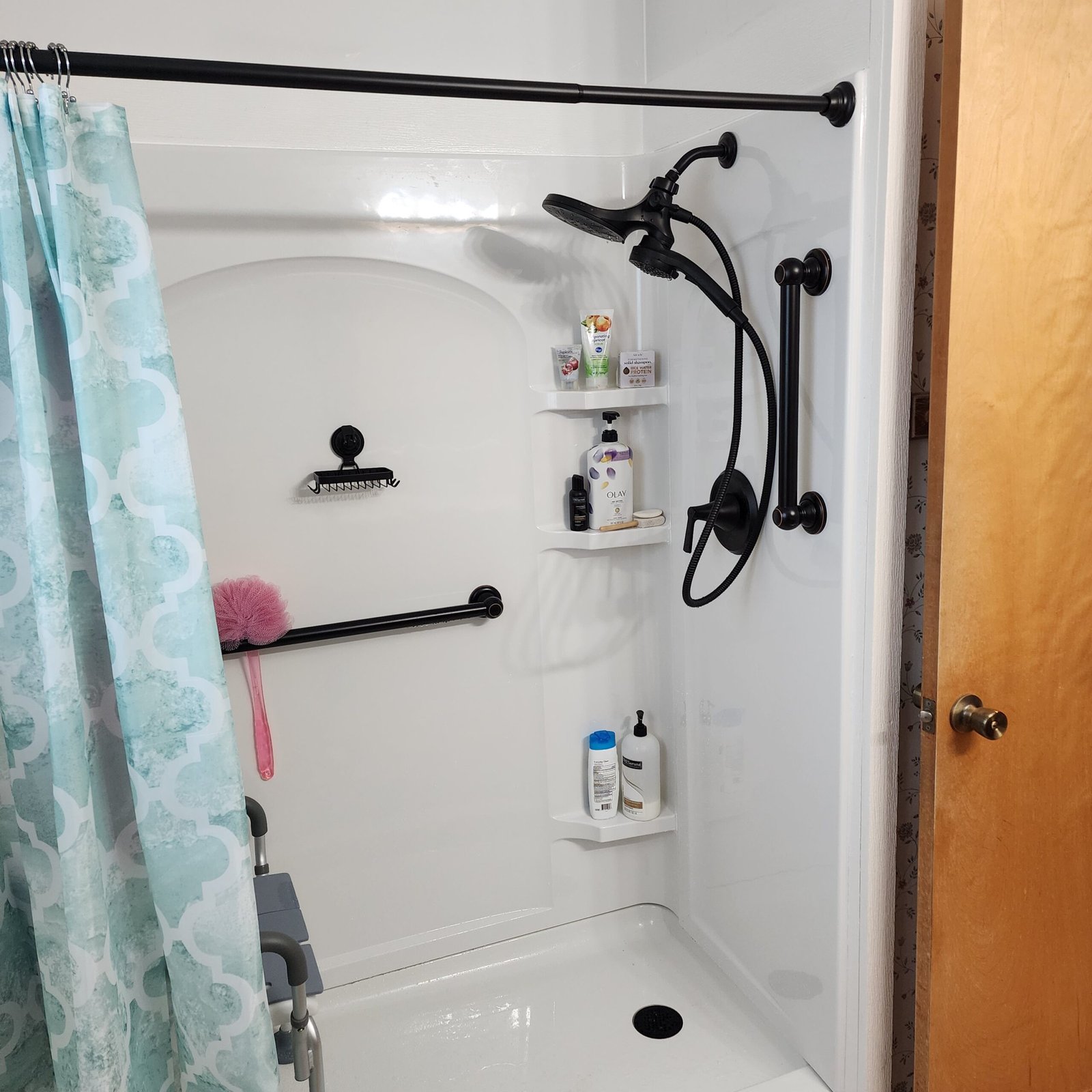
Horizontal, vertical, and diagonal grab bars create different hand paths. A horizontal bar provides side-to-side coverage at one height. A vertical bar provides several grip heights at one wall location. A diagonal bar changes both height and lateral position as the hand moves. The right orientation is the one that matches the actual movement and can be mounted responsibly without creating a conflict.
EazyStep Bath reviews these hand paths when planning grab bar installation for homeowners across its Lexington, Jackson, and West Tennessee service area. Orientation, natural reach, wall support, fixtures, and clearances must work together.
1. Compare coverage before choosing a location
Orientation is not decoration. It determines where a hand can land and where that hand can travel while holding the bar. Compare the three options in simple geometric terms before discussing exact placement.
Horizontal
The gripping surface extends left and right at one height. This gives the user lateral coverage but little change in grip height.
Vertical
The gripping surface extends up and down at one wall location. This gives a range of grip heights but little side-to-side coverage.
Diagonal
The gripping surface changes height and lateral position together. Its direction matters because the high end and low end serve different points in the movement.
That comparison does not select a bar by itself. Return to the movement-first grab bar placement guide and identify the approach, first reach, transition, second position, and exit. A bar can look well placed in a still photograph and fail to remain useful through the complete sequence.
2. A horizontal bar keeps the grip at a consistent height
A horizontal bar is worth considering when a person needs a handhold across a wider section of wall without moving the hand substantially higher or lower. The useful question is not “Are horizontal bars best?” It is “Does the hand need to travel sideways while staying near this height?”
That may apply while a person repositions along a shower wall, steadies at more than one point beside a bathing area, or reaches from slightly different standing positions. The tradeoff is direct: horizontal coverage comes at one selected height. A user who reaches much higher during approach and lower during another phase may not find one horizontal bar useful for both.
Length does not cure a poor height. Nor does a familiar height from a diagram prove that it fits a particular person or private bathroom. Mark the proposed line temporarily, then check it from every position in the normal routine. Do not perform a movement that is painful, medically restricted, or unstable merely to test a mark.
3. A vertical bar offers several grip heights at one transition point
A vertical bar is worth considering when the user approaches one part of the wall but reaches at different heights during the movement. Near a tub wall or shower threshold, for example, the first hand position may be higher than the grip used after the step. A vertical surface can make both heights available without requiring the hand to travel far sideways.
A peer-reviewed laboratory study compared several bathtub grab-bar configurations after induced balance perturbations. Its abstract reports that both age groups favored a side-wall vertical bar during bathtub entry and exit. That is relevant evidence for studying a vertical handhold near a transition, but it is not a universal placement rule. The room, task, user, wall, and complete support plan still control the decision.
Vertical coverage also has a limit. If the person changes position laterally along a long wall, one vertical bar may be reachable only at the beginning or end of the movement. A combination of orientations may fit a sequence better than asking one bar to do every job.
Not sure which hand path fits the movement?
EazyStep Bath can review the reach, orientation, finished surface, mounting path, fixtures, and clearances for a focused grab bar installation. Bring the movement description, preferred hand, and photographs of the full wall area.
4. A diagonal bar is directional
A diagonal bar is not simply a compromise between horizontal and vertical. As the hand moves sideways, it also moves higher or lower. That path may feel logical for a specific rise or descent, but reversing the movement reverses the relationship. The high end, low end, dominant hand, and direction of travel all matter.
Before considering a diagonal orientation, draw an arrow showing the intended hand travel. Check where the hand begins, whether it slides or changes grip, and where it must release. Then repeat the review for the reverse movement. A diagonal line that follows the rising phase may be awkward during lowering, approach, or exit.
Do not angle a bar merely to reach convenient framing without checking the user’s movement. Mounting structure is essential, but structure and reach must be solved together. If the useful line and a responsible mounting path do not agree, reconsider the bar length, orientation, mounting system, or nearby support points.
5. Accessibility standards and private-home planning answer different questions
The U.S. Access Board’s ADA Standards specify horizontal positioning for grab bars covered by Section 609.4. The Access Board’s toilet-room guide separately notes that ICC A117.1 requires an additional vertical grab bar at water closets in facilities governed by that standard, while the ADA Standards do not require that additional bar. This distinction matters. “ADA,” “code,” and “best for this existing home” are not interchangeable labels.
A private home may not be governed by the same provisions as a covered public facility. Conversely, a project that must comply with an applicable accessibility or building standard cannot substitute personal preference for the required layout. Determine which requirements apply before using a standard’s dimensions or orientation.
The Access Board also treats structural strength as a complete path through the bar, fastener, mounting device, and supporting structure. Orientation does not excuse weak attachment. The selected assembly must match the wall and installation conditions, and its gripping area cannot be compromised by nearby controls, shelves, trim, glass, or other obstructions.
6. Use a five-part orientation decision test
- Name the movement. State whether the person is approaching, stepping, turning, sitting, rising, standing, or exiting.
- Trace the hand path. Does the useful reach move mostly sideways, mostly up and down, or in a specific rising or descending direction?
- Test both directions. Entry and exit, sitting and rising, or approach and departure may require different hand positions.
- Check the room system. Review wall surface and concealed conditions, controls, plumbing risk, shelves, door operation, glass, fixtures, and cleaning access.
- Assign unresolved questions. An installer evaluates mounting and fit. A qualified health professional should guide decisions controlled by balance, strength, pain, recovery, cognition, or transfer technique.
Photographs and temporary tape marks can organize the discussion, but they do not reveal concealed wall conditions or approve a final location. The broader bathroom mobility assessment guide explains how to build a useful evidence packet before buying hardware.
Horizontal, vertical, and diagonal grab bar questions
Are horizontal grab bars always better than vertical bars?
No. Horizontal bars provide lateral coverage at one height, while vertical bars provide several grip heights at one wall location. The better orientation is the one that matches the actual hand path, can be reached through the movement, and can be mounted responsibly.
When might a diagonal grab bar make sense?
A diagonal bar may be considered when its specific rising or descending path matches the intended movement. Check the high end, low end, preferred hand, travel direction, reverse movement, wall support, and nearby conflicts before choosing it.
Do ADA grab bar rules require every home bar to be horizontal?
No. ADA Section 609.4 specifies horizontal positioning for grab bars covered by that provision, but those requirements are not automatically a complete prescription for every existing private home. First determine which standards apply to the project.
Can orientation be chosen before the wall is evaluated?
You can identify a preferred hand path, but final selection should wait until the useful reach, finished surface, mounting path, fixtures, controls, glass, and selected bar requirements can be considered together.
Match the bar to the movement and the wall
Ask Mike to review the complete grab bar plan
EazyStep Bath provides focused grab bar installation in Lexington and Henderson County, Jackson and Madison County, and nearby West Tennessee communities. Suitability depends on the user’s movement, actual site conditions, mounting system, fixtures, and clearances.
Explore grab bar installation Call EazyStep Bath Request service
Sources and scope
- U.S. Access Board: ADA Chapter 6, Section 609 Grab Bars
- U.S. Access Board: Guide to the ADA Accessibility Standards, Bathing Rooms
- U.S. Access Board: Guide to the ADA Accessibility Standards, Toilet Rooms
- PubMed: Use of Different Bath Grab Bar Configurations Following a Balance Perturbation
- PubMed: Force Applied to a Grab Bar During Bathtub Transfers
This article is an educational planning guide. It is not medical advice, an occupational-therapy assessment, a code-compliance determination, or a promise that a grab bar will prevent a fall or injury. Applicable requirements, the user’s needs, actual site conditions, and the selected product’s instructions control the final plan.