


When a bathtub wall is difficult to step over, the main alternatives are to lower part of the tub wall, change the movement with a properly selected transfer bench, add a separate handhold where mounting allows, or replace the bathing fixture. These options solve different problems. Start by deciding whether the barrier, the transfer movement, the need for support, or the entire bathing setup is the real obstacle.
EazyStep Bath evaluates existing tubs for CleanCut Step conversions across its Lexington, Jackson, and West Tennessee service area when the tub wall is the main obstacle and keeping the existing fixture may still make sense.
1. Define what is difficult about the tub entry
A high tub wall is visible, but it may not be the only problem. Watch the complete sequence from the dry bathroom floor to the bathing position and back out. The difficult point might be lifting one foot high enough, balancing while the foot is raised, finding a reliable handhold, turning inside the tub, lowering to a seat, or standing again.
Write the problem in one sentence. For example: “The user can stand and shower but cannot comfortably lift a foot over the tub wall,” or “The user needs to sit before moving both legs into the tub.” Those two situations should not automatically receive the same product.
If pain, balance, strength, recovery, cognition, or a medical restriction affects the transfer, ask an occupational therapist or another qualified health professional to evaluate the person and movement. An installer can assess the tub, wall, floor area, and mounting conditions. That is not a substitute for a clinical assessment.
2. Lower part of the existing tub wall
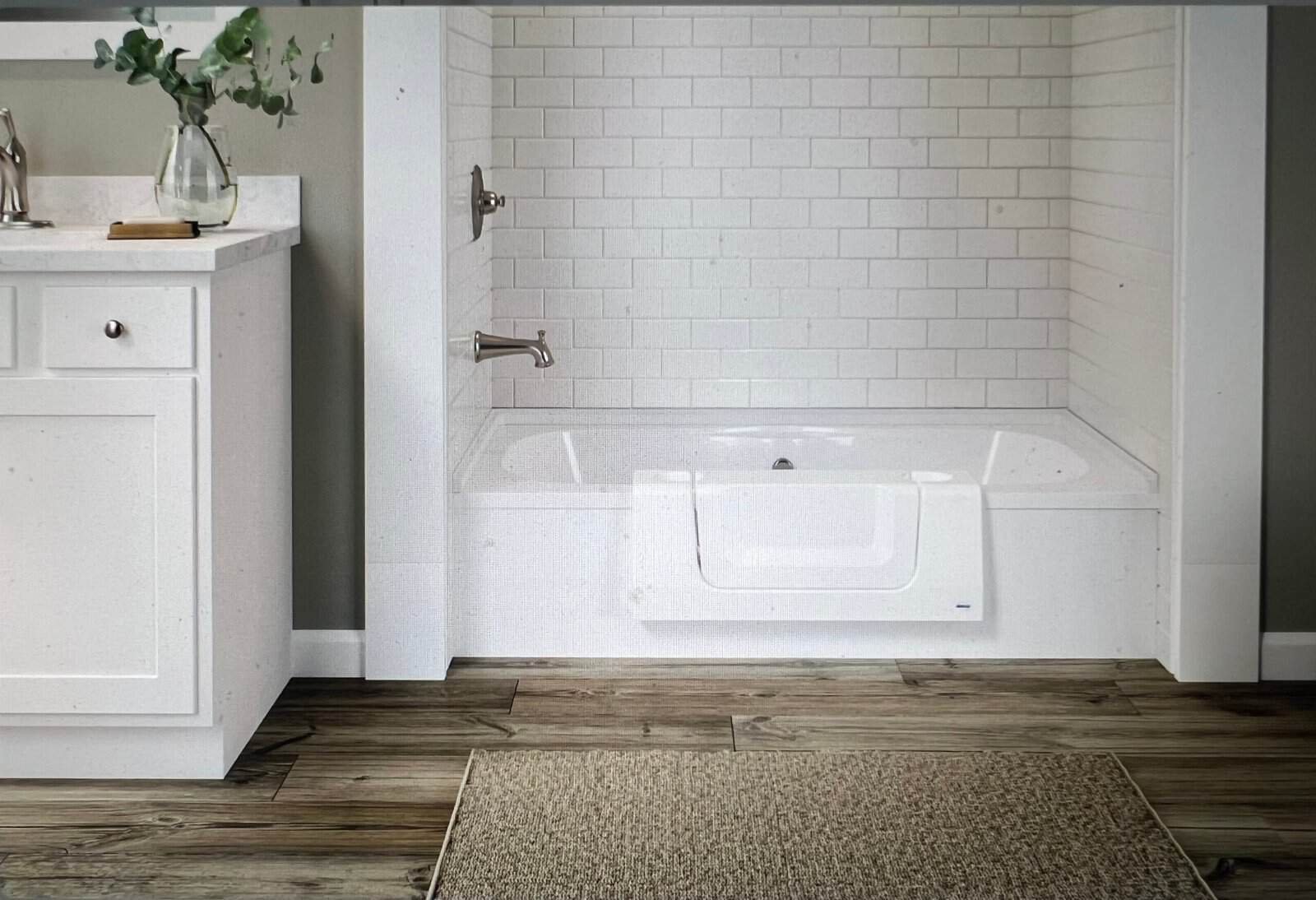
A step-through conversion removes and finishes a section of the existing bathtub wall to create a lower opening. This directly changes the barrier while keeping the tub in place. It can be a focused option when the tub and surrounding bathroom are otherwise serviceable.
The manufacturer describes the CleanCut Step as an insert that changes an existing tub into a step-in shower. CleanCut also makes a Convertible with a removable center section for households that need to switch between a step-through opening and full-depth bathing. The product choice depends on the intended use and the tub.
Compatibility cannot be decided from the tub’s color or general shape alone. Review the material, wall construction, dimensions, condition, liner, jets, and existing enclosure. The manufacturer’s current FAQ says sliding tub doors must be removed for its conversion and cannot be put back on. A curtain may be needed instead. That matters because an existing door track can occupy the same tub rim needed for the opening.
A lower opening is still a threshold. It does not create a barrier-free shower, and it does not solve every balance, turning, or standing problem. Measure the expected remaining step height and compare it with the user’s actual movement before choosing this path.
Is the existing tub worth keeping if the wall were lower?
EazyStep Bath evaluates compatible tubs for CleanCut Step bathtub installation in Lexington and Henderson County, Jackson and Madison County, and nearby West Tennessee communities. Mike reviews the tub, measurements, enclosure, access, and surrounding conditions before confirming the work.
3. Change the movement with a transfer bench
A tub transfer bench extends across the tub wall so a user can sit from the dry side and move the legs across while seated. This changes the task. It does not alter the tub wall itself.
The U.S. Department of Veterans Affairs includes tub transfer bench and shower-chair assembly resources in its current physical-therapy and occupational-therapy materials. The important practical point is not simply that the equipment exists. The bench must suit the person, tub, floor area, weight requirements, transfer direction, and bathing routine, and the user may need professional instruction.
Check the dry-side footprint, leg adjustment, tub-bottom contact, curtain arrangement, controls, and the route used to approach the bench. Existing sliding-door tracks can conflict with a transfer across the open tub face. The U.S. Access Board’s bathing-room guidance also treats clear floor space, transfer access, seats, controls, and enclosures as one coordinated layout in covered accessible facilities. Its technical dimensions do not automatically prescribe a private-home installation, but the coordination principle is useful.
EazyStep does not present a bench as a universal answer. A bench may be the right category when seated transfer is appropriate, or it may introduce a new reach, clearance, or caregiver problem. Have the equipment and technique evaluated before relying on it.
4. Add a separate support point when the wall can accept it
A grab bar can provide a purpose-built handhold during approach, entry, standing, turning, or exit. It does not reduce the tub-wall height. If the main limitation is leg clearance, adding a bar alone may leave the central problem unchanged.
Start with the movement and natural reach, then reconcile that location with the mounting path. The bar, fastener, mounting device, finished surface, and supporting structure must work together. Our grab bar placement planning guide explains that sequence in detail.
Do not plan to hold a shower door, towel bar, soap dish, or faucet. A shower door is an enclosure component, not a support device. If glass and a grab bar are both present, coordinate their paths so the bar remains reachable and the door operates without interference.
5. Consider replacing the bathing fixture when the whole setup is wrong
Some households need a shower with a lower entry, a walk-in bathing fixture, or a different bathroom layout. Replacement may deserve consideration when the existing tub is damaged, incompatible with a focused modification, poorly located, too cramped for the needed transfer, or no longer useful for the household’s bathing routine.
This is a larger scope than a tub-wall insert. It can affect plumbing, wall finishes, flooring, waterproofing, clearances, doors, and the time the bathroom is unavailable. EazyStep Bath performs tub-to-shower conversions and complete bathroom remodeling when replacing the bathing area is the appropriate scope.
Do not choose replacement merely because it is the biggest option, and do not reject it merely because a smaller product exists. Choose the smallest intervention that actually addresses the movement, room, and future use without creating a second problem.
6. Compare the bathtub step-over alternatives
Step-through tub conversion
Changes: the height and shape of part of the tub wall.
Check: tub compatibility, remaining threshold, bathing needs, liner or jets, and enclosure conflicts.
Transfer bench
Changes: the movement from a standing step-over to a seated transfer.
Check: the user, technique, equipment fit, floor space, controls, curtain, and caregiver access.
Grab bar
Changes: the available handhold during a defined movement.
Check: natural reach, wall surface, structure, mounting system, controls, and glass.
Fixture replacement
Changes: the bathing fixture and potentially the surrounding room.
Check: complete project scope, plumbing, waterproofing, clearances, schedule, and future use.
Before requesting installation, collect the tub’s overall height, wall thickness, material if known, clear photographs of the tub and enclosure, the available dry-floor space, and a one-sentence description of the difficult movement. Use the broader bathroom mobility checklist to make sure the walking path, lighting, wet surfaces, and route out are not being ignored.
Bathtub step-over questions
What is the smallest change that can lower a bathtub entry?
A compatible step-through tub conversion lowers a section of the existing tub wall without removing the entire tub. The remaining threshold, tub condition, dimensions, material, and enclosure still need evaluation.
Does a transfer bench remove the bathtub wall?
No. A transfer bench changes the movement by allowing a seated transfer across the tub wall. The equipment and technique must fit the user, tub, floor space, controls, and bathing routine.
Will a grab bar solve a high tub wall?
A grab bar can provide a separate handhold, but it does not lower the tub wall. Decide whether the main problem is the barrier height, the need for support, or both.
Can full-depth bathing be retained after a tub-wall conversion?
Some conversion products use a removable watertight center section so the tub can switch between a step-through opening and full-depth bathing. Product fit, sealing surfaces, intended use, and maintenance requirements must be reviewed.
Choose the option that solves the actual obstacle
Ask Mike to evaluate the tub for a lower step-through opening
EazyStep Bath can review a focused CleanCut Step request in Lexington and Henderson County, Jackson and Madison County, and nearby West Tennessee communities. Final suitability depends on the existing tub, measurements, material, condition, enclosure, access, and site conditions.
Explore CleanCut Step installation Call EazyStep Bath Request a tub evaluation
Sources and scope
- CleanCut: CleanCut Step manufacturer information
- CleanCut: CleanCut Convertible manufacturer information
- CleanCut: current product and compatibility FAQ
- U.S. Department of Veterans Affairs: physical therapy and occupational therapy resources
- U.S. Access Board: Guide to the ADA Accessibility Standards, Bathing Rooms
This article is an educational options guide. It is not medical advice, an occupational-therapy assessment, a code-compliance determination, or a promise that a product or modification will prevent a fall or injury. The user’s needs, product instructions, and site conditions control the final choice.